Skip to content

admin

Beyond access: the intersecting role of AAC, literacy, and technology (Zimmerman, 2025)

  • by

Jordyn Zimmerman is a nonspeaking autistic person who was segregated and denied access to effective augmentative communication until she was 18. In her paper, Beyond Access: the Intersecting Role of AAC, Literacy, and Technology,  she calls for “a more user-centered design approach across the board—where AAC users are not merely participants, but leaders in the design and development process, ensuring this work is reflective of people’s needs and serves to meaningfully include in our increasingly digital world.”

Now free at the AAC journal at https://doi.org/10.1080/07434618.2025.2504499

Unveiling underlying systemic isolation challenges for AAC users (Blasko, 2025)

  • by

Grant Blasko is 22 years old, autistic, a full-time user of AAC, and a university student. In his article, “Unveiling underlying systemic isolation challenges for AAC users”, he “encourages collaboration between AAC users, researchers, and service providers to reevaluate communication support goals with a focus on preventing isolation and enhancing relational support.”

Now free at the AAC journal
https://doi.org/10.1080/07434618.2025.2515279

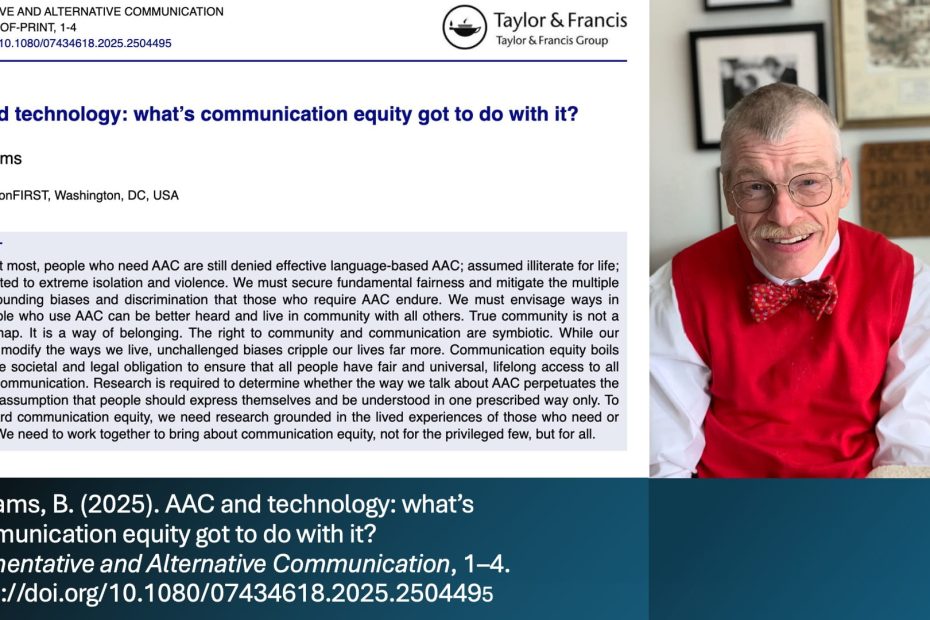
Bob Williams and a quote

Reading, writing, and AAC are fundamental (Williams, 2025)

  • by

Bob Williams emphasizes the importance of literacy and communication access for individuals using AAC, advocating for strategic actions to secure their rights. Now freely available at https://doi.org/10.1080/07434618.2025.2508492